
Tumbling Terminology
When you see gymnasts, cheerleaders, or kids on the playground "cartwheeling" around, it can look effortless. However, there is more to tumbling classes than cartwheels. This guide to tumbling terminology below will help explain some of tumbling's most frequently used skills. At all levels of tumbling, these skills provide the foundation for future, harder tricks.
Main Tumbling Skills:
- Handstand - Standing vertically but inverted (upside down) with hands on floor, head neutral, legs straight & together.
- Lunge - Basic starting position for many skills where the back leg is straight behind hips resting on the floor, and the front leg is in front of the hips with the knee bent nearly 90º.
- Cartwheel - CW - A skill that turns 90º from a lunge to a lunge, touching 6 points of contact that looks similar to wagon wheel spokes.
- Round Off - RO - A skill that uses the shoulder to push off while traveling through a ½ turn. Starts in a lunge and finishes with feet together.
- Front Handspring - FHS - Springing off the hands while traveling forward through a handstand position, usually starting from a lunge position and finishing with feet together.
- Back Handspring - BHS - Springing off the hands while traveling backwards through a handstand position, usually starting and ending with feet together. More on how to teach a back handspring here.
- Back Tuck - BT - Jumping nearly vertical in the air while performing a backwards somersault in a tucked or knees to chest motion.
- Punch Front - PF - Jumping nearly vertical in the air while performing a forwards somersault in a tucked or knees to chest motion. Usually done after “punching” the floor with both legs to create lift.
- Aerial - A skill that involves head over heel rotation without the support of the hands. Usually done as a CW, RO, or Front Walkover without the support of the hands.
How is Tumbling different than Gymnastics?
Gymnastics is about learning various skills on 4 different apparatus, i.e. Bars, Beam, Vault and Floor Exercise. Tumbling is learning to move the body in mainly a head over heels rotation as well as turning the body in varying degrees, often called “twisting”. Tumbling can be on a variety of surfaces and for many purposes. If you are considering tumbling class enrollment, check out the skill differences in skill level below.
Tumbling Levels:
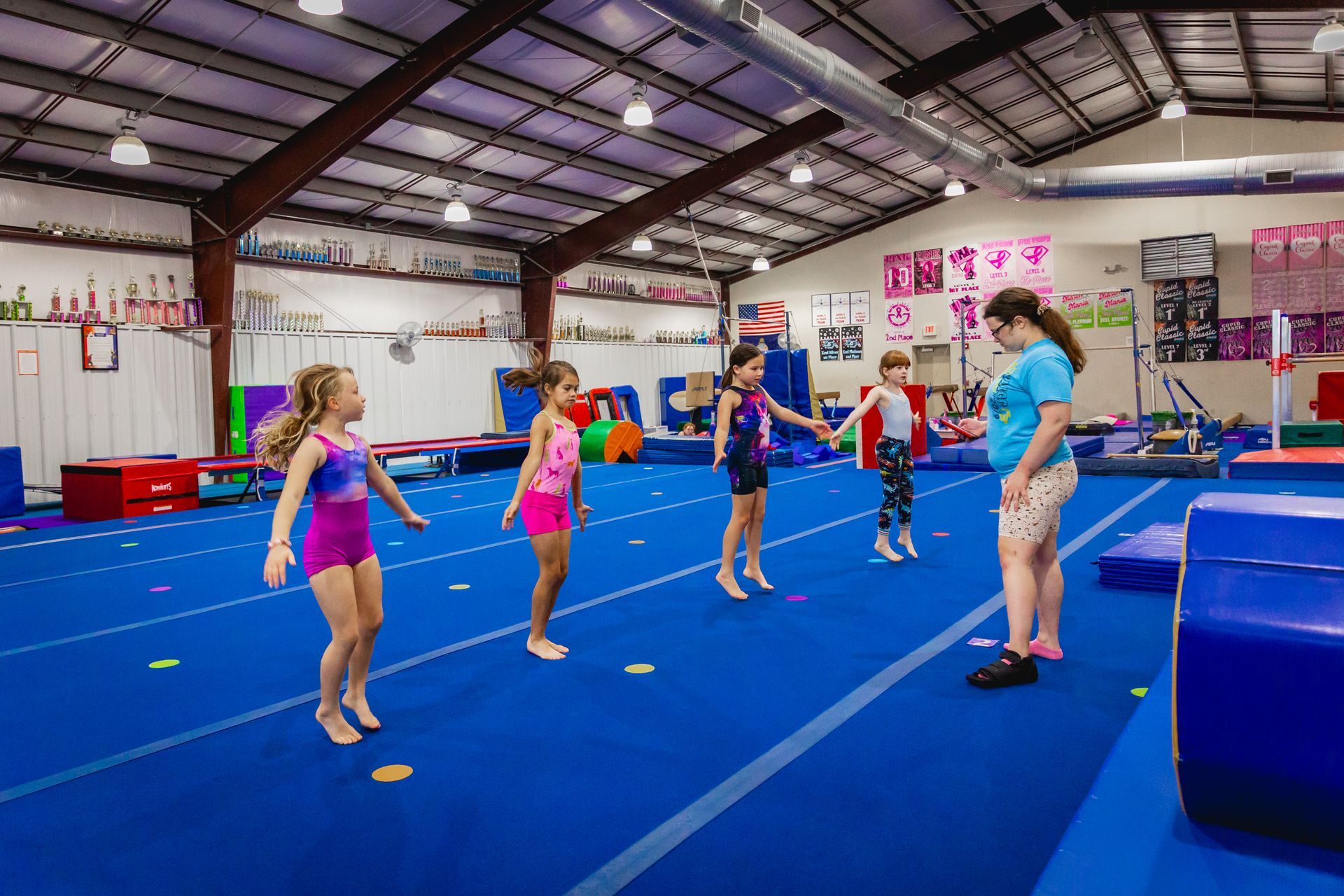
T101 5-8 Year Old - This is an intro course for our younger athletes that want to learn to “flip”. We focus on learning the Handstand, Cartwheel, Round Off, and Back Handspring in this class that utilizes our Recreational Equipment and Areas of the gym.
T101 9+ - This is an intro course for our athletes that want to learn to “flip”. We focus on learning the Handstand, Cartwheel, Round Off, Back Handspring, and Front Handspring and we utilize our Team side of the gym for larger space and safe sized equipment.
T102 - This is a class that is for our athletes that have passed T101 and need a bit more of a challenge in connecting the Round-off and the Back Handspring.
T201 - This is an intermediate class that follows T102 & T101 classes where we focus on the Back Tuck and Round Off sequences.
T301 - This is an advanced class that follows T201 where we continue to focus on the flipping skills that follow basic Back Tucks and we introduce and work on in air twisting.
Pinnacle in 3-D: Coaching, Development, and Success