
What to Expect at Your Child’s First Gymnastics Meet
Attending your child’s first gymnastics meet can be exciting, nerve-wracking, and full of unforgettable memories. If your young gymnast is preparing a gymnastics meet - understanding how the meet operates, the event order, warm-ups, and how to manage jitters can help both parents and athletes feel confident and prepared.
Understanding How a Gymnastics Meet Works
Most gymnastics meets operate in a "Capital Cup" format. This means that the athletes will warm up and compete on the same piece of equipment before rotating to the next event. Athletes rotate in the same order each competition regardless of what event they start on. This is called Olympic Order - Vault, Bars, Beam, Floor. For example, if a gymnast starts competing on Beam, they will go to Floor next, followed by Vault, and ending on Bars. In this format, there are two vaults, two sets of bars, two beams, and one floor. This allows some athletes to be warming up while other athletes are competing keeping a nice flow to the meet and minimizing wait times.
Open Stretch
Athletes should arrive inside the venue approximately 15 minutes prior to the start of open stretch. This will give the athlete time to familiarize themselves with the arena before joining their teammates and coaches on the competition floor. Only athletes, coaches, and event volunteers are allowed within the competition area. Parents and spectators must stay in the stands for the duration of the competition. Don't worry - coaches are professional hair fixers, tape tearers, and nerve tamers!
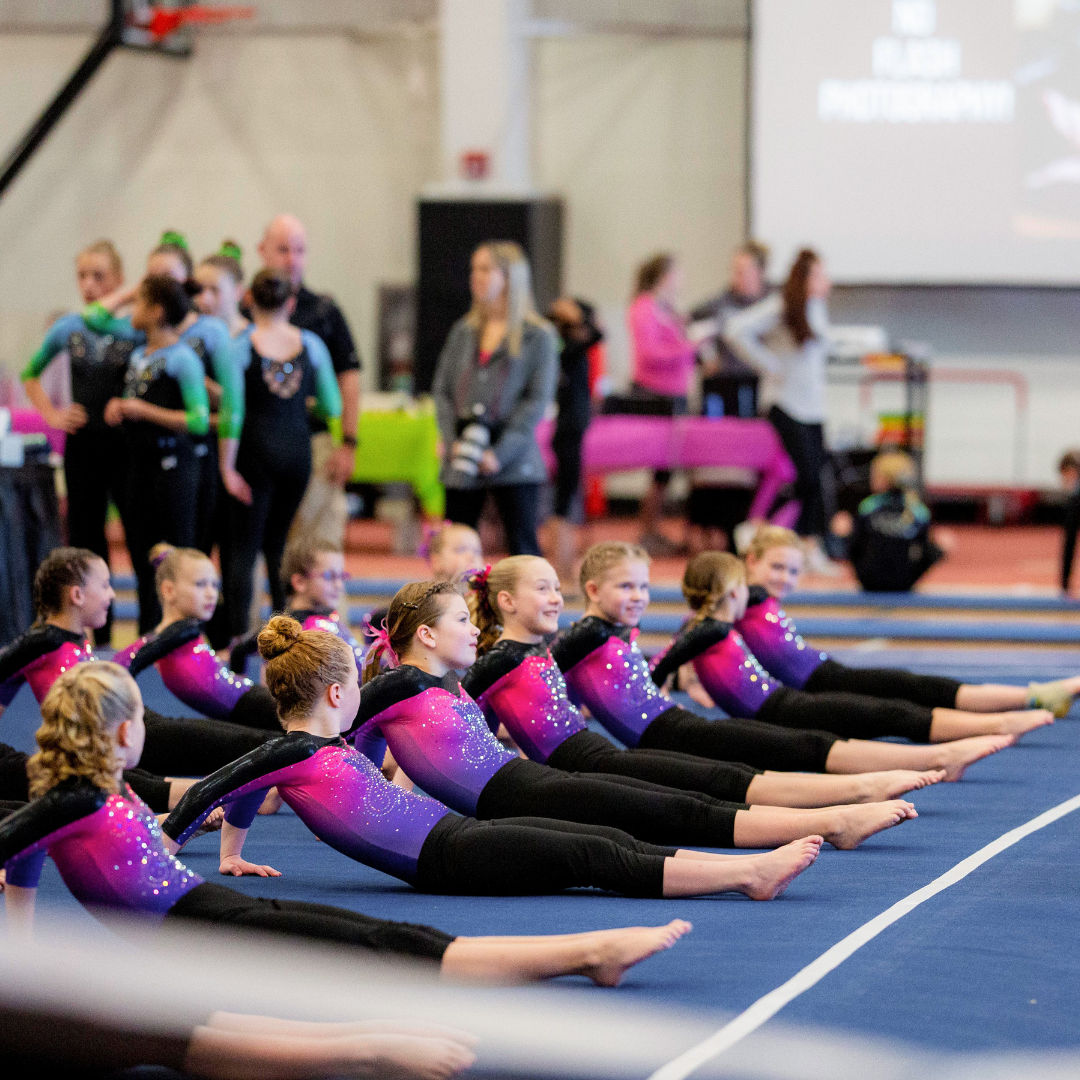
Open stretch lasts between 20 to 30 minutes. It allows athletes time to warm their bodies and practice some basic tumbling skills and drills. At the end of open stretch, athletes will be presented by club at their starting event. Following announcements, athletes in Flight A will begin their timed warm ups. Athletes in Flight B will wait to warm up their first event until athletes in Flight A start their competition routines.
Event Warm Ups
Event warm ups vary in length based on level and number of athletes. Vault warm ups are the same for every squad and are based on the number of athletes in the
largest squad in that session. Bar and Beam warm ups vary based on the level and number of athletes warming up at one time. Floor warm ups are done in between floor routines while judges are calculating their scores. The only floor group that will warm up together is the very first squad to compete on floor that session.
| Level | Time Per Athlete |
|---|---|
| Bronze | 30 sec |
| Silver | 45 sec |
| Gold | 1 min |
| Platinum | 1.5 min |
| Diamond & Sapphire | 2 min |
| 3 | 45 sec |
| 4 & 5 | 1 min |
| 6 & 7 | 1.5 min |
| 8, 9, & 10 | 2 min |
| 9 & 10 Bars | 2.5 min |
Event Competition
On vault, bars, and beam - once the entire squad has completed their timed warm ups, competition will begin. Floor competition is continuous throughout the session. Judges will be seated at a table near the apparatus. At most invitational meets, coaches set the competitive order by handing the judges cards with the athletes' names on them. At State, Regional, and National meets, the competition order is preset and listed on a rotation sheet. The judge will raise a hand or flag and call the gymnast's name signaling the beginning of the routine. Judges will judge the routine that is performed. An athlete signals the end of their routine by saluting to the judges after their dismount.
How Long Does a Gymnastics Meet Last?
Most gymnastics meets last around 3-4 hours from the beginning of open stretch to the end of awards. All athletes are expected to attend their session. Some clubs encourage athletes to support their teammates by attending other sessions as a spectator. If an athlete attends a session as a spectator, they must remain in the stands and will not be allowed on the competition floor.
Understanding Gymnastics Scores
Gymnastics judging is complicated. Judges must study and take tests to show mastery in their abilities. Judges have different ratings that signify what levels they are certified to judge. In addition to testing, judges participate in continuing education and volunteer hours each year to keep their rating. Below are a few key points to help you understand how judges come up with gymnastics scores.
Start Value
In the USA Gymnastics program, the highest start value is a 10.0. Depending on the program and routine, an athlete's start value can vary.
Start value is based on the elements in the routine that receive value part credit. Start value is made up of three main parts: special requirements, value part elements, and bonus (Level 9, 10, and Sapphire only).
- Special requirements are parts of a routine that are required for every athlete in that level to perform. Each special requirement is worth .5.
- Value part elements are labeled from A to E. A is the easiest and E is the most difficult.
- Bonus is achieved in two forms: connective value - performing skills in a row or difficulty - performing D or E skills.
Xcel Start Values
In the Xcel program, each level has four special requirements and a certain number of value part elements to perform in order to maximize their start value. If an athlete performs all required skills and all special requirements, their start value for Xcel Bronze - Diamond will be a 10.0. If a Sapphire athlete meets the same criteria, their start value will be a 9.6. Sapphire athletes have the opportunity to earn bonus by doing harder skills and skills in connection to bring their start value up to a 10.0. Extra bonus above a 10.0 does not add any additional tenths to the start value. The maximum is a 10.0.
Compulsory Start Values
In the Developmental Program levels 1-4, all routines have a 10.0 start value. Deductions for missed elements are taken away from the 10.0 start value. Most level 5 routines also have a 10.0 start value. There are some routine modifications, such as a swing half turn dismount instead of a flyaway off bars, that change the start value to a 9.5.
Optional Start Values
Levels 6, 7, and 8 follow the Xcel model where performing the four special requirements and required value parts will bring your start value to a 10.0. Level 9 and 10 are similar to Sapphire and have the opportunity to earn bonus to bring the start value up to a 10.0. When all special requirements and value parts are met, Level 9s achieve a base start value of a 9.7 and Level 10s achieve a base start value of 9.5. Level 10s can earn one extra tenth toward their routine for performing an E element and having six tenths of bonus. Level 10s cannot score above a 10.0, but they can receive one extra tenth of start value.
This table shows the required value part elements by level.
| Level | As | Bs | Cs |
|---|---|---|---|
| Bronze | 4 | 0 | 0 |
| Silver | 5 | 0 | 0 |
| Gold | 6 | 0 | 0 |
| Platinum | 6 | 1 | 0 |
| Diamond | 5 | 2 | 0 |
| Sapphire | 3 | 3 | 1 |
| 6 | 5 | 1 | 0 |
| 7 | 5 | 2 | 0 |
| 8 | 4 | 4 | 0 |
| 9 | 3 | 4 | 1 |
| 10 | 3 | 3 | 2 |
Execution Deductions
Once the judges have determined the start value, they will deduct the execution errors from the start value. Execution deductions are taken for breaks in form (bent arms, flexed feet), breaks in rhythm (pauses in between elements), as well as wobbles, steps on landings, and falls. Falls are a .5 deduction at all levels. In compulsory levels 1-5, the dance on beam and floor is also evaluated for exactness including head and arm positions, musicality, and artistic performance. Execution deductions can range from .05 up to .3 or .5 depending on the event, skill, and error. This gives the judges the ability to separate athletes that have minor form breaks from those that have major form errors.
- For Levels 1-7 and Xcel levels, the combination of start value minus execution determines the final score. For Levels 8-10, additional deductions are taken for routine composition. Composition relates to the variety and difficulty of elements in a given routine. It is meant to reward athletes in a level that are performing routines with harder skills from those that are performing easier routines.
- There are also overall deductions such as posture, footwork, and artistry that can be utilized by judges to rank the athletes in the correct order.
Final Scores
Once judges have their score, if there are two judges, they will average their score to provide a final score for the athlete. Judges have to be within a certain range of each other. If they are not, they will have a conference to discuss what they saw and agree upon a fair score for the athlete.
Petitions
Coaches can petition to have the start value of a routine changed. When a coach petitions, the score could go up, down, or stay the same. Petitions are only valid for start value concerns. Coaches cannot petition execution deductions or because the score seems lower than they thought it should be. It is a good idea to video your child's routines in case a coach needs video evidence for their petition. Petitions at a gymnastics meet are rare, but do generally occur at least once over the course of the weekend. The Meet Referee helps coaches determine if filing a petition will benefit the athlete and also works with acting judges to review.
Displaying Good Sportsmanship
It is important to display good sportsmanship throughout the competition. We love hearing athletes cheer for their teammates and other competitors. Gymnastics takes a lot of courage to perform individually in front of a packed crowd. All athletes should remain in the competition area until the last competitor in the session is done.
Awards
Awards are held at the end of the competition. Athletes are divided into age groups. Sometimes age groups are based on actual age, but frequently they are divided evenly based on the number of athletes in the competition. For example, a session with 60 athletes may be divided into 4 groups of 15. Awards are given out to approximately the top 50% of athletes. Vault, bars, beam, floor and all around awards will be given out to individuals in each age group. Team awards are given out at the end of that level's competition. Typically the team award is calculated by adding up the top three scores on each event, regardless of age group. Athletes are required to stay until the end of awards, even if their age group has already been called. This is a display of good sportsmanship.
After the Meet
There are a variety of emotions at the end of a competition, and each competitor is likely to react differently. Some competitions end with a lot of joy and others end with some sadness. We teach our athletes that there is always something positive to look at from the results of the day. We recommend that you celebrate the small victories and help athletes set achievable goals for the next meet. Coaches will be reviewing the results to evaluate practice plans and adjust accordingly to improve performance. Coaches will be relaying key deductions back to athletes so that they can improve over time. If a parent has a question about a score, you are encouraged to ask your child's coach for more information. If a parent finds themselves frustrated after a competition, we ask that you wait a minimum of 24 hours before reaching out to your child's coach to allow time to process.
- Athlete's role - to find something they did well that day
- Coach's role - to look for areas of improvement and plan to correct in practice
- Parent's role - to be the #1 fan
Goals and Bribery
Intrinsic motivation is necessary for long term success in the sport of gymnastics. This means that athletes need to be motivated from within and develop a desire to want to improve. Bribery counteracts intrinsic motivation and can make gymnastics less about personal growth and skill development and instead it becomes transactional. Bribery also infers that an athlete is not trying their hardest until they are externally motivated. Bribery is different than celebration. The key difference is the word "if". Celebrations are always welcome after the meet and encouraged regardless of the results at awards.
Goal setting in gymnastics needs to be attainable and in the control of the athlete. For example, athletes do not have control over the judges, so setting a goal of getting a 9.0 on bars is not a goal we want our athletes to set. Athletes can control their form, so setting a goal of having straight legs in their kips is a great goal - and also might help them score a 9.0! Breaking down goals into small, controllable parts helps athletes stay motivated and find bits of success throughout each competition.
Gymnastics is a marathon, not a sprint.
True athlete development comes from years and years of practice and dedication. Each competition is a stepping stone in your athlete's gymnastics journey and should be celebrated for lessons learned - both positive and negative. There will come a day that your child participates in their last gymnastics meet. What incredible memories will you make as a family along the way?
Pinnacle in 3-D: Coaching, Development, and Success